
Data center operations depend on more than the equipment installed inside a server hall. Reliable connectivity requires carrier availability, physically separated fiber routes, controlled entrance facilities, documented handoff points, network monitoring, and maintenance procedures that reduce avoidable single points of failure.
Reliable data center connectivity depends on more than having multiple network providers. True network resilience requires carrier diversity, physically diverse fiber routes, separate building entrances, documented handoff points and operational processes designed to reduce single points of failure. For organizations evaluating colocation and critical infrastructure, these factors can directly affect uptime, redundancy and business continuity.
Why Is Data Center Connectivity Important?
Connectivity matters in data center operations because applications, users, cloud environments, business partners, and remote systems must exchange data with infrastructure housed inside the facility. A carefully planned server environment can still experience disruption when its external or internal network design depends on one vulnerable pathway.
Connectivity planning should examine the complete network path rather than only the final carrier handoff. This includes regional fiber availability, outside-plant routes, underground conduits, access chambers, building entrance points, distribution spaces, internal pathways, network equipment, monitoring systems, and operational procedures.
The appropriate design depends on the workload, location, risk profile, service model, compliance considerations, and business continuity requirements. AI infrastructure, enterprise applications, cloud platforms, and latency-sensitive services may each require different carrier, bandwidth, monitoring, and route arrangements.
What Is Carrier Diversity?
Carrier diversity means having access to more than one telecommunications provider or network option. Within data center operations, carrier diversity can provide greater flexibility when selecting connectivity, planning capacity, negotiating service arrangements, or responding to a provider-specific incident.
Carrier diversity should not, however, be confused with physical route diversity. Two services purchased from different carriers may still share ducts, access chambers, utility poles, local exchanges, long-distance infrastructure, or the same building entrance. A single excavation, fire, equipment failure, flood, or access restriction could therefore affect both connections.
Carrier diversity and physical route diversity
Carrier diversity concerns the organisations delivering connectivity. Route diversity concerns the physical and logical paths used to deliver that connectivity. Effective data center operations should assess both areas rather than assuming that multiple contracts provide complete separation.
Meaningful route separation may involve different property approaches, independently routed conduits, separate entrance locations, distinct internal pathways, and reviewed upstream dependencies. Complete separation may not always be available, but shared components should be identified so decision-makers understand the remaining exposure.
How Should Fiber Routes Be Evaluated?
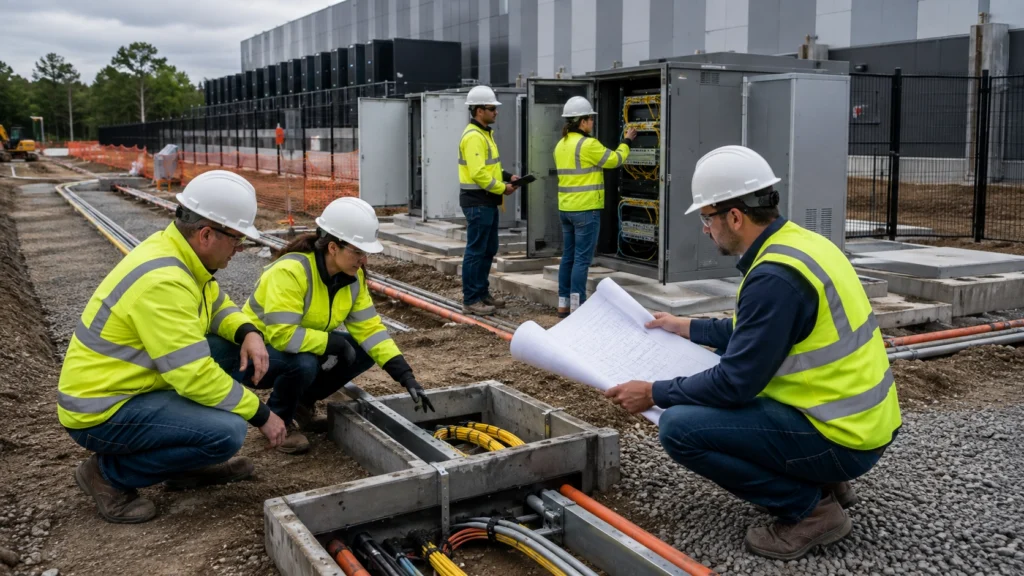
Fiber routes should be evaluated from the wider telecommunications network through the site boundary and into the relevant network room. Reviewing only a diagram of the final connection can conceal shared infrastructure and physical dependencies that may affect data center operations.
A practical route assessment should consider:
- Which carriers and network providers are available near the proposed site.
- Whether the proposed services use separate regional and local routes.
- Where conduits, utility poles, access chambers, or pathways are shared.
- Whether routes approach the property from different directions.
- Where each route crosses the site boundary and enters the building.
- Whether internal pathways remain separated after entering the facility.
- How carrier equipment, handoff points, and cross-connections are secured.
- How maintenance access can be provided without affecting unrelated connections.
Route documentation should be updated as infrastructure changes. Construction activity, roadworks, carrier consolidation, network migrations, site expansion, and new equipment can change the actual dependency structure even when older drawings remain unchanged.
Which Connectivity Risks Can Data Center Operations Reveal?
Structured data center operations can reveal network dependencies that are not obvious from a carrier list or bandwidth quotation. These may include shared access chambers, common ducts, one building entrance, a single internal riser, shared power for network equipment, undocumented cross-connections, or limited space for future pathways.
Logical diversity also requires attention. Separate physical connections may still depend on the same routing configuration, network device, upstream provider, management platform, or operational team. Organisations should document which failures the design is intended to tolerate and which dependencies remain outside the facility’s direct control.
Carrier and route diversity can reduce particular concentrations of risk, but they do not guarantee uptime or eliminate connectivity incidents. Reliable data center operations still require monitoring, incident response, tested escalation procedures, capacity management, configuration control, and accurate records.
Data Center Operations Connectivity Planning Table
The following table summarises practical areas to evaluate when reviewing connectivity and related facility planning.
| Data center operations area | What to evaluate | Why it matters |
|---|---|---|
| Carrier diversity | Available providers, handoff options, commercial independence, and upstream dependencies | Supports provider choice and reduces reliance on one carrier relationship |
| Physical route diversity | Outside-plant routes, conduits, chambers, site approaches, entrances, and internal pathways | Identifies shared physical points that could affect multiple connections |
| Network security | Controlled access, equipment zoning, configuration governance, logging, and monitoring | Helps protect network infrastructure and maintain accountable operations |
| Operational documentation | Current route drawings, inventories, carrier contacts, change records, and escalation paths | Supports maintenance, incident investigation, compliance readiness, and informed decisions |
| Scalability | Spare conduits, pathway capacity, rack space, equipment power, cooling, and expansion areas | Allows connectivity infrastructure to adapt to changing workloads |
| Facility infrastructure | Power, monitoring, maintenance access, and self-contained closed loop cooling | Supports the physical environment required by computing and network equipment |
| Community and facility planning | Community partnership, quiet facility operations, construction access, and utility-cost considerations | Supports responsible planning intended to ensure the development does not increase local utility costs |
How Do Monitoring and Documentation Support Data Center Operations?
Monitoring and documentation support data center operations by helping technical teams identify faults, understand dependencies, coordinate maintenance, and respond consistently. Physical diversity has limited value when teams cannot identify affected services, confirm route status, or locate accurate escalation information during an incident.
Useful operational records may include route drawings, circuit identifiers, carrier details, equipment inventories, network diagrams, approved configurations, access logs, maintenance schedules, incident histories, escalation contacts, test results, and change approvals. These records should reflect the installed or planned environment rather than only the original design.
Network monitoring can provide visibility into capacity, availability, errors, latency, equipment condition, and abnormal behaviour. Monitoring does not prevent every failure, but it can help qualified teams identify developing issues and isolate affected components.

How Do Security and Compliance Readiness Affect Connectivity?
Connectivity infrastructure should form part of the physical security, access governance, documentation, and risk-management processes used in data center operations. Carrier entrance areas, network rooms, distribution cabinets, patching locations, and monitoring platforms can all affect the security of the wider facility environment.
Access should be appropriate to each operational role and technical area. Changes to network routes, circuits, devices, or configurations should be authorised and recorded. Organisations should also establish which controls belong to the facility, carrier, tenant, or another provider so responsibilities are not left unclear.
Carrier diversity is not a certification or automatic proof of compliance. It is one infrastructure consideration that may support continuity planning, risk assessment, access control, incident handling, and audit evidence where these areas are relevant to an organisation’s requirements.
How Does Cooling Support Data Center Operations and Connectivity?
Cooling supports data center operations because switches, routers, optical equipment, monitoring systems, servers, and supporting electrical equipment generate heat. Network rooms and distribution areas should therefore be included in thermal planning rather than treated as secondary spaces.
Crystal Peaks includes self-contained closed loop cooling within its broader infrastructure-planning approach. For planned facilities, cooling design should be coordinated with equipment layouts, airflow containment, sensors, maintenance access, power distribution, network pathways, and potential expansion. The exact engineering solution should be determined for the relevant site and workload.
Community Partnership and Responsible Facility Planning
Responsible data center operations extend beyond the server hall because fiber construction, maintenance access, facility noise, utility coordination, and future expansion may affect nearby residents and organisations. Early community partnership can help project teams communicate planned work and understand local considerations before construction and operational decisions are finalised.
Crystal Peaks’ planning approach includes quiet facility operations and responsible consideration of surrounding areas. Connectivity routes, mechanical systems, access points, delivery paths, maintenance areas, landscaping, and site boundaries should be coordinated so technical activity can be managed with appropriate separation and controlled access.
The company also states that its approach is planned so surrounding communities do not experience increased local utility costs. This position should not be expanded into promises concerning electricity rates, municipal pricing, taxation, subsidies, utility agreements, or unrelated infrastructure costs.

How Does Crystal Peaks Approach Data Center Operations and Connectivity?
Crystal Peaks Data Centers states that it pre-maps fiber access routes and carrier availability during early site planning. This approach can help identify connectivity constraints before later development and design decisions make route changes more difficult.
The company’s wider data center operations planning approach connects network infrastructure with site readiness, cooling, power, security, compliance considerations, scalability, documentation, and community impact. These areas are intended to be considered as coordinated components of planned infrastructure rather than isolated systems.
Readers can review Crystal Peaks’ information about data center site planning and design, critical infrastructure planning, planned enterprise colocation sites, and data center pre-leasing opportunities. Facility status, carrier availability, route design, capacity, and project timing should be confirmed for each location.
Frequently Asked Questions
Why are carrier diversity and route planning important in data center operations?
They help organisations identify dependence on individual providers, conduits, entrances, network devices, and upstream routes. They can reduce certain single-point-of-failure risks but do not guarantee uninterrupted connectivity.
Does using two carriers automatically provide route diversity?
No. Two carriers may share outside-plant infrastructure, access chambers, building entrances, internal pathways, or upstream network dependencies. Data center operations teams should assess the physical and logical routes separately.
How does self-contained closed loop cooling relate to connectivity?
Self-contained closed loop cooling forms part of the planned facility environment supporting servers, network devices, and related electrical equipment. Cooling should be coordinated with equipment layouts, monitoring, airflow, maintenance access, and expansion planning.
How can data center operations support community partnership?
Early planning can address construction routes, fiber approaches, maintenance access, facility boundaries, and communication with nearby residents and organisations. Crystal Peaks also includes quiet facility operations and planning intended not to increase local utility costs.
How does Crystal Peaks approach data center operations and carrier planning?
Crystal Peaks states that it pre-maps fiber access routes and carrier availability during early site planning. Its approach is intended to coordinate connectivity with security, scalability, power, documentation, self-contained closed loop cooling, and community considerations.
Review Connectivity as Part of Complete Data Center Operations
Carrier diversity should be evaluated alongside physical routes, entrances, internal pathways, network equipment, monitoring, security, cooling, documentation, and maintenance procedures. Organisations reviewing future data center operations requirements can explore Crystal Peaks Data Centers’ planned locations, colocation information, pre-leasing material, and project-specific information.