

Critical infrastructure connectivity requires resilient network architecture that keeps essential systems accessible during failures, maintenance and unexpected disruption. Effective planning considers carrier diversity, physically separate network routes, secure access, monitoring, failover procedures and the data center infrastructure supporting each connection. For critical workloads, the goal is to reduce single points of failure while maintaining secure and reliable connectivity.
For critical infrastructure, network resilience is the ability of a communications environment to continue supporting essential functions, adapt to disruption and recover when equipment, routes or external services become unavailable. It does not mean that failures cannot occur. Instead, it depends on identifying likely failure points, separating dependencies where practical and documenting how traffic, personnel and operations will respond.
Why Is Critical Infrastructure Connectivity Important?
Connectivity matters because critical infrastructure workloads often depend on timely, controlled and continuous communication between users, applications, storage platforms, cloud environments and operational systems. A data center may have suitable computing space, power and cooling, but those resources cannot support the intended workload effectively when network paths are poorly planned or difficult to maintain.
Critical infrastructure planning should begin by identifying which services are genuinely essential, where their users and dependent systems are located, and what happens when a primary connection fails. A healthcare platform, financial processing system, enterprise application or operational database may have very different latency, recovery, security and physical-access requirements.
Location also affects critical infrastructure connectivity planning. Regional data center infrastructure may help place systems closer to important users and operational markets, but geographic proximity alone does not establish resilience. The available carriers, physical fiber paths, network handoff arrangements and external dependencies still need to be evaluated.

How to Evaluate Network Resilience for Critical Infrastructure
A practical critical infrastructure resilience review should examine the full communication path rather than treating the internet connection as a single product. Carrier diversity, physical route separation, internal network architecture, monitoring, maintenance procedures and recovery responsibilities can each affect whether an alternative path remains usable during a disruption.
Carrier and Service-Provider Diversity
Multiple carrier names do not automatically mean independent connectivity. Two providers may depend on common upstream infrastructure, shared conduit, the same building entrance or another common point outside the facility. Buyers should ask how services enter the site, where paths converge and which portions of the route are genuinely separate.
Physical Path Separation
Physically separated entry points can reduce exposure to a single excavation, equipment failure, fire, flooding event or access restriction. The degree of separation should be reviewed from the facility boundary through the carrier handoff and into the tenant environment. A diagram showing separate lines is not sufficient when both lines share an undocumented external dependency.
Internal Network Architecture
Inside a critical infrastructure facility, organisations should review how network cabinets, cross-connects, patching, switches, routers and tenant equipment are arranged. Segmentation can help contain faults and limit unnecessary access, while clearly documented dependencies make maintenance and incident response more manageable. The design should reflect the organisation’s own availability, security and compliance requirements rather than a generic topology.
Monitoring and Recovery Procedures
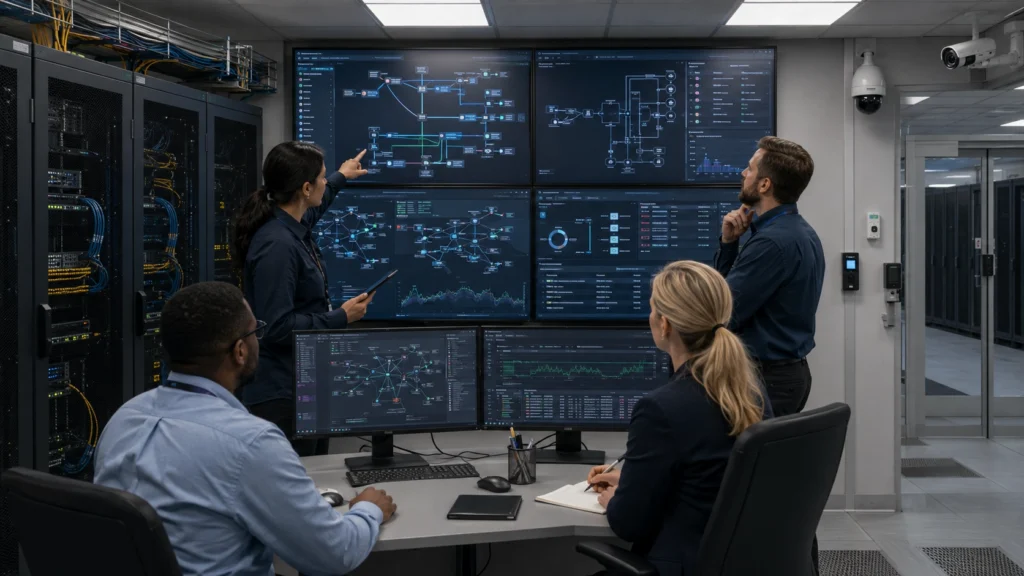
Critical infrastructure resilience depends on detecting problems and responding correctly. Monitoring should provide useful visibility into connectivity status, equipment health and significant changes. Recovery plans should identify who investigates an incident, who has authority to reroute traffic, how providers are contacted and how normal operations are restored after the problem is contained.
How Should Organisations Evaluate Data Center Access Options?
Critical infrastructure access should be evaluated as both a physical and operational requirement. Organisations may need planned access for equipment installation, scheduled maintenance, emergency work, auditing or authorised vendor support. The access model should make those activities possible while preserving appropriate controls around restricted areas.
Important questions include whether access is scheduled or available under defined conditions, how identities and permissions are managed, how visitors and contractors are handled, and how access events are documented. Organisations should also determine which responsibilities belong to the facility and which remain with the tenant or its service providers.
Remote support options can reduce the need for every task to require a tenant visit, but their scope should be clearly defined before an organisation depends on them. Access arrangements, response expectations and permitted activities should be confirmed through the relevant project documentation or agreement rather than assumed.
Critical Infrastructure Connectivity Planning Checklist
The following critical infrastructure table summarises practical areas that organisations can examine when comparing planned data center environments. Individual requirements will depend on the workload, risk assessment, operating model and contractual arrangements.
| Planning area | What to evaluate | Why it matters |
|---|---|---|
| Carrier access | Available providers, handoff locations and upstream dependencies | Different provider names may still share infrastructure |
| Route diversity | Physical entrances, conduits, pathways and convergence points | True separation can limit common failure exposure |
| Internal network design | Segmentation, cross-connects, equipment paths and documentation | Clear architecture supports fault isolation and controlled change |
| Physical access | Authorisation, visitor handling, maintenance access and event records | Essential work should remain possible without weakening controls |
| Monitoring and recovery | Alerting, escalation, rerouting and restoration procedures | Alternative infrastructure only helps when it can be used correctly |
| Cooling support | How self-contained closed loop cooling is incorporated into facility planning | Network and computing equipment depend on controlled operating conditions |
| Community and site planning | Community partnership, quiet facility operations and planning that does not increase local utility costs | Connectivity development should be considered alongside nearby residents, organisations and local infrastructure |
What Common Connectivity Gaps Can Weaken Resilience?
Common critical infrastructure connectivity gaps include assuming that two contracts equal two independent routes, overlooking shared infrastructure outside the building and failing to test whether alternative paths can carry the intended workload. Other weaknesses arise when network diagrams are outdated, access permissions are unclear or recovery procedures depend on people who are unavailable during an incident.
- Two network providers use the same conduit or upstream route.
- Backup connectivity has insufficient capacity for essential operations.
- Failover depends on an undocumented or manual process.
- Network equipment cannot be reached safely during maintenance.
- Monitoring identifies an outage but not its location or dependency.
- Physical access and network responsibilities are divided without clear ownership.
- Cooling, power or security dependencies are excluded from the connectivity review.
Resilience assessments should therefore include realistic failure scenarios. These may include the loss of a carrier, a damaged route, unavailable equipment, restricted site access, a configuration error or a supporting facility-system problem. The purpose is not to predict every possible incident, but to understand whether the planned response is proportionate and workable.
How Does Cooling Support Network and Facility Resilience?
Critical infrastructure cooling supports resilience by maintaining conditions in which network, storage and computing equipment can operate within their specified limits. Connectivity planning should therefore consider the equipment environment as part of the wider facility system rather than treating fiber and network hardware in isolation.
Crystal Peaks Data Centers includes self-contained closed loop cooling in its intended facility approach. Within a planned data center environment, this type of cooling consideration forms part of the broader relationship between equipment layout, thermal management, monitoring, maintenance access and operational documentation.
The exact cooling configuration, capacity and operating parameters remain project-specific and should be confirmed for the relevant site and deployment. The presence of a cooling design should not be interpreted as a guarantee of network availability or workload performance.
How Do Security and Compliance Affect Connectivity Decisions?
Critical infrastructure security and compliance affect how networks are segmented, monitored, accessed and documented. Organisations should map connectivity decisions to their own risk-management and governance requirements, including who may access equipment, how changes are approved and which records need to be retained.
Crystal Peaks plans security considerations from the infrastructure-planning stage, including access points, segmentation zones, credential management, monitoring and incident-response mapping. These are planning elements rather than confirmation that a facility or tenant environment holds a specific certification.
Organisations can review Crystal Peaks’ approach to data center security planning and its broader data center services and infrastructure planning. Requirements for a specific workload should still be validated against the relevant site documentation, tenant design and applicable organisational policies.
Community Partnership and Responsible Facility Planning
Critical infrastructure connectivity affects more than the organisations using the data center. Fiber construction, site access, facility placement, maintenance activity and supporting infrastructure can also affect nearby residents, businesses and community organisations. Responsible planning should therefore consider how technical requirements interact with the surrounding area.
Crystal Peaks’ intended approach includes community partnership, consultation around relevant site considerations and planning for quiet facility operations. This does not imply universal community approval. It means that nearby residents and organisations should be considered while access routes, facility boundaries, equipment placement, construction activity and operating procedures are developed.
The company’s stated planning position is that its development approach does not increase local utility costs. This point should be interpreted narrowly and should not be expanded into assumptions about municipal rates, taxes, subsidies, electricity pricing or individual customer savings.
Community-focused development also benefits from clear distinctions between a proposed facility, infrastructure under development, pre-leasing activity and an operational data center. Project-specific status, location details and construction information should be confirmed directly before organisations or community stakeholders rely on them.

How Is Crystal Peaks Approaching Critical Infrastructure Connectivity?
Crystal Peaks Data Centers is approaching critical infrastructure connectivity as a planning issue involving proximity, carrier access, cooling, physical security, network architecture and tenant requirements. Its enterprise colocation planning describes planned sites around connectivity, control, secure access and infrastructure requirements rather than presenting them as completed operational environments.
The company’s data center pre-leasing information also states that it works with long-haul fiber providers as part of infrastructure-readiness planning. Prospective tenants should confirm the carriers, routes, handoff options, site status and deployment conditions applicable to the specific opportunity under review.
Crystal Peaks does not need to act as a telecommunications carrier or managed network provider for connectivity to remain an important part of facility planning. The relevant question is how the planned site can accommodate tenant and carrier requirements while maintaining clear boundaries between facility infrastructure, carrier services and tenant-managed systems.
Frequently Asked Questions
What should organisations check when evaluating critical infrastructure connectivity?
Organisations should evaluate carrier availability, physical route separation, network architecture, monitoring, recovery procedures, equipment access and supporting facility dependencies. They should also confirm which responsibilities belong to the carrier, facility and tenant.
Does having two network carriers create full resilience?
No. Two carriers may still share conduit, entry points or upstream infrastructure. Organisations should confirm physical and logical separation and determine whether each connection can support essential operations during a disruption.
How does self-contained closed loop cooling relate to connectivity?
Self-contained closed loop cooling forms part of the planned operating environment for network and computing equipment. It should be evaluated alongside equipment layout, monitoring, maintenance access and other facility systems, but it does not by itself guarantee network availability.
How do community partnership and quiet facility operations affect data center planning?
Community partnership and quiet facility operations encourage planners to consider nearby residents and organisations when evaluating facility boundaries, access, acoustic factors, construction activity and operating procedures. They do not imply that every stakeholder has approved a proposed project.
How does Crystal Peaks address connectivity without increasing local utility costs?
Crystal Peaks includes connectivity, utility coordination and infrastructure requirements in its planning approach, which is intended so that surrounding communities do not experience increased local utility costs. Project-specific connectivity, utility and facility details still require confirmation.
Review Future Connectivity Requirements with Crystal Peaks
Organisations assessing critical infrastructure should document their connectivity, access, security, recovery and facility requirements before selecting a future data center environment. Review Crystal Peaks’ planned pre-leasing opportunities or contact Crystal Peaks Data Centers to discuss relevant project information. Site status, available carriers, routes, timelines, technical specifications and commercial terms should be confirmed for the individual project.