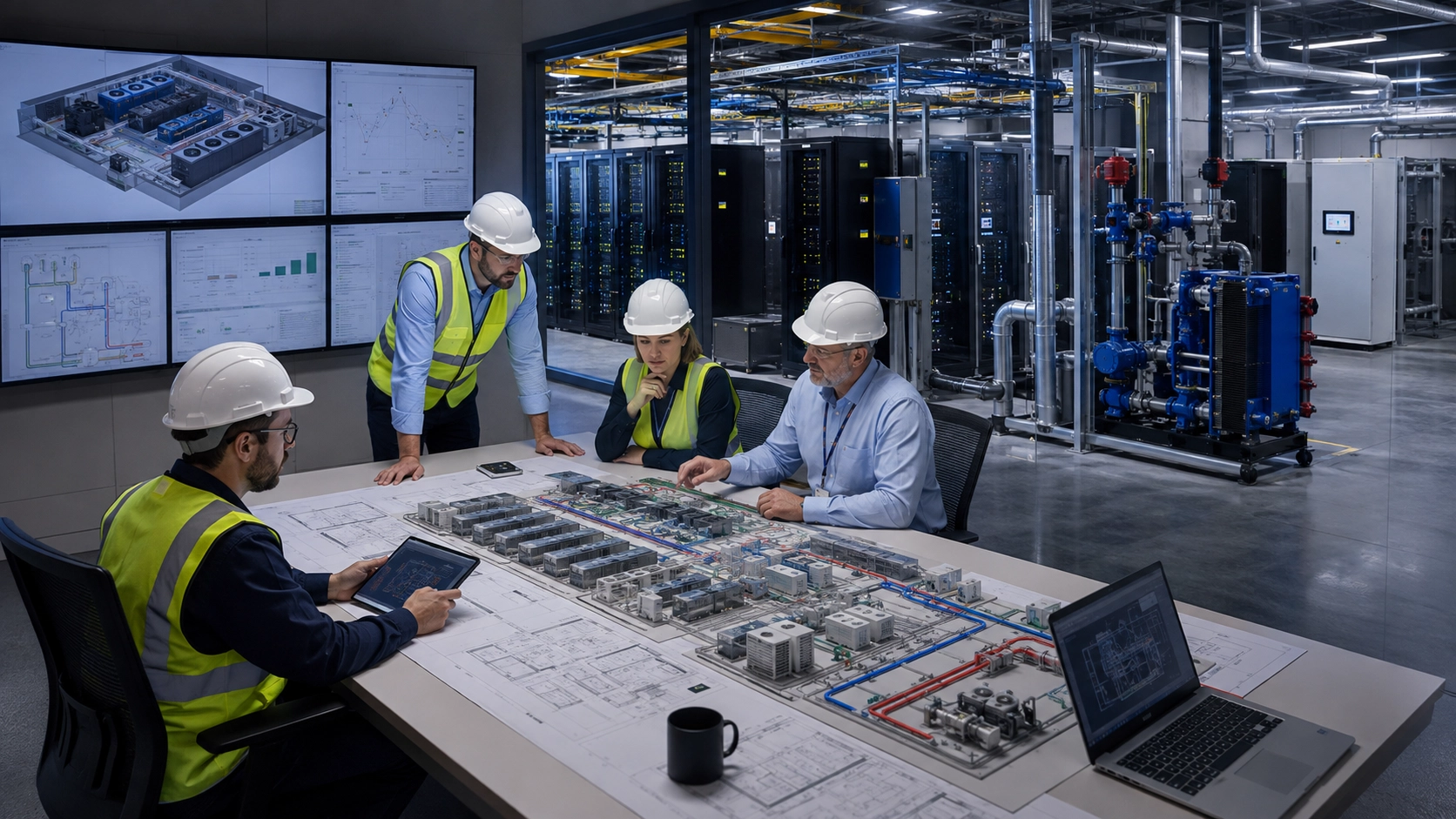
Data center cooling solutions support long-term cloud infrastructure planning by helping organizations align thermal capacity with computing demand, equipment density, facility growth, maintenance requirements, and operational controls. Cooling should therefore be evaluated as a core infrastructure system rather than as equipment selected only after server and network layouts have been decided.
Data center cooling solutions support cloud infrastructure that depends on physical servers, storage systems, networking equipment, power distribution, connectivity, security controls, and supporting mechanical systems. Although cloud resources may appear flexible to users, the facilities behind them still operate within physical power, space, and temperature limits. A cooling design that cannot adapt to changing loads may restrict how much equipment can be installed, how racks are arranged, or how the facility can expand.
This makes early planning for data center cooling solutions important in cloud, colocation, private infrastructure, and high-density computing environments. The objective is not to select the most complex cooling technology. It is to establish a controlled and maintainable system that matches the expected equipment, deployment phases, operating conditions, and long-term infrastructure strategy.
Why Do Cooling Decisions Affect Cloud Infrastructure Planning?
Data center cooling solutions affect cloud infrastructure planning because every computing deployment creates heat that must be removed under normal, changing, and maintenance conditions. Rack density, workload patterns, equipment specifications, airflow, pipework, facility layout, monitoring, and expansion plans all influence the required cooling architecture.
The National Institute of Standards and Technology describes cloud infrastructure as the hardware and software that enables cloud computing characteristics such as resource pooling and rapid elasticity. The physical environment must therefore be capable of supporting changes in deployed computing resources, even when demand does not remain constant.
Data center cooling solutions planned only around the first equipment deployment may create constraints later. Additional racks could exceed available thermal capacity, new hardware may require different cooling interfaces, or poorly placed mechanical equipment could limit expansion and maintenance access. Long-term planning should consider both the expected initial load and credible future configurations without assuming that every potential expansion will occur.
What Should Data Center Cooling Solutions Be Planned Around?
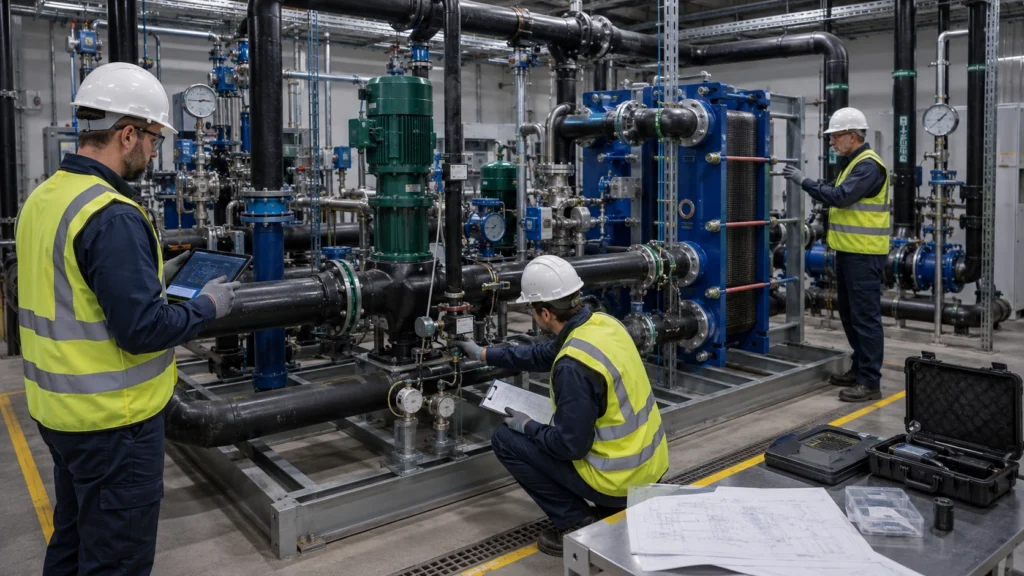
Data center cooling solutions should be planned around the actual thermal characteristics of the proposed IT environment, the facility layout, maintenance requirements, monitoring strategy, resilience objectives, and expected deployment phases. Generic assumptions are not a substitute for equipment-level and facility-level analysis of data center cooling solutions.
ASHRAE guidance addresses equipment operating conditions, temperature and humidity measurement, airflow patterns, equipment placement, and manufacturer heat-load requirements. These considerations show why cooling is not limited to installing mechanical units. Air and liquid paths, rack arrangement, containment, controls, sensors, and operating procedures must work as a coordinated system.
- Equipment requirements: Server, storage, network, and accelerator hardware may have different inlet, airflow, and liquid-cooling requirements.
- Rack and room layout: Cabinet placement affects airflow paths, containment, pipe routing, service clearances, and heat concentration.
- Workload patterns: Cloud and AI workloads may produce variable or concentrated thermal loads that should be considered during capacity planning.
- Monitoring: Temperature, pressure, flow, humidity, equipment status, and leak-detection data may help operators identify changing conditions.
- Maintenance access: Pumps, heat exchangers, valves, sensors, filters, and distribution equipment should remain safely accessible.
- Expansion sequencing: Cooling distribution should be coordinated with planned server halls, network routes, electrical systems, and future deployment areas.
How Can Cooling Support Long-Term Scalability?
Data center cooling solutions can support scalability when the thermal design is coordinated with realistic infrastructure phases. This includes identifying where capacity may be added, how cooling equipment could be extended, which distribution routes must be reserved, and whether later equipment could require air cooling, liquid cooling, or a combination of methods.
Scalability does not mean installing every component at the beginning of a project. It means avoiding design decisions that unnecessarily block later development. Mechanical space, pipe routes, controls, isolation points, structural loading, electrical supply, and maintenance access may all affect whether cooling capacity can be expanded without major disruption.
When evaluating data center cooling solutions, organizations should also distinguish between computing scalability and facility scalability. Virtual resources may be provisioned rapidly, but additional physical capacity still depends on available racks, power, cooling, connectivity, and operational support. A cloud infrastructure plan should connect these physical dependencies to projected workload growth.
Which Cooling and Facility Factors Should Be Reviewed?
A structured review of data center cooling solutions helps organizations identify dependencies before layouts and equipment choices become difficult to change. The following table connects cooling considerations with broader cloud infrastructure and facility planning.
| Planning area | What should be evaluated | Long-term relevance |
|---|---|---|
| Data center cooling solutions and IT load | Expected hardware, heat output, airflow, liquid-cooling interfaces, and load variation | Helps align cooling capacity with credible deployment phases |
| Air and liquid distribution | Containment, airflow paths, pipework, pumps, heat exchangers, valves, and isolation boundaries | Supports controlled heat removal and future system changes |
| Self-contained closed loop cooling | System boundaries, recirculation, monitoring, water quality, leak response, and maintenance access | Provides a defined cooling approach that can be considered during phased infrastructure planning |
| Controls and monitoring | Sensor coverage, alarms, trend data, access permissions, records, and escalation procedures | Supports operational visibility, review, and documented decision-making |
| Security and compliance readiness | Access to mechanical areas, change records, maintenance documentation, and incident procedures | Helps connect cooling operations with wider governance controls |
| Community and facility planning | Community partnership, equipment placement, acoustic controls, quiet facility operations, and utility planning | Supports responsible planning that does not increase local utility costs |
How Does Self-Contained Closed Loop Cooling Support Planning?
Self-contained closed loop cooling supports planning by establishing a defined system in which coolant is circulated through controlled pipework and heat-transfer equipment. Its relevance depends on the specific design, equipment interfaces, heat-rejection method, controls, maintenance strategy, and operating conditions.
A closed loop does not remove the need for detailed engineering. Designers still need to evaluate heat exchangers, pumps, valves, distribution routes, pressure, flow, water or coolant quality, isolation, leak detection, maintenance access, controls, and the final method used to reject heat from the facility.
The system boundary should also be clear. Facility teams and tenants need to understand which equipment belongs to the facility cooling system, which components serve individual racks or IT equipment, and where operational responsibility changes. This becomes particularly important in colocation environments that may accommodate equipment with different thermal requirements.
How Should Cooling Be Integrated with Monitoring and Maintenance?
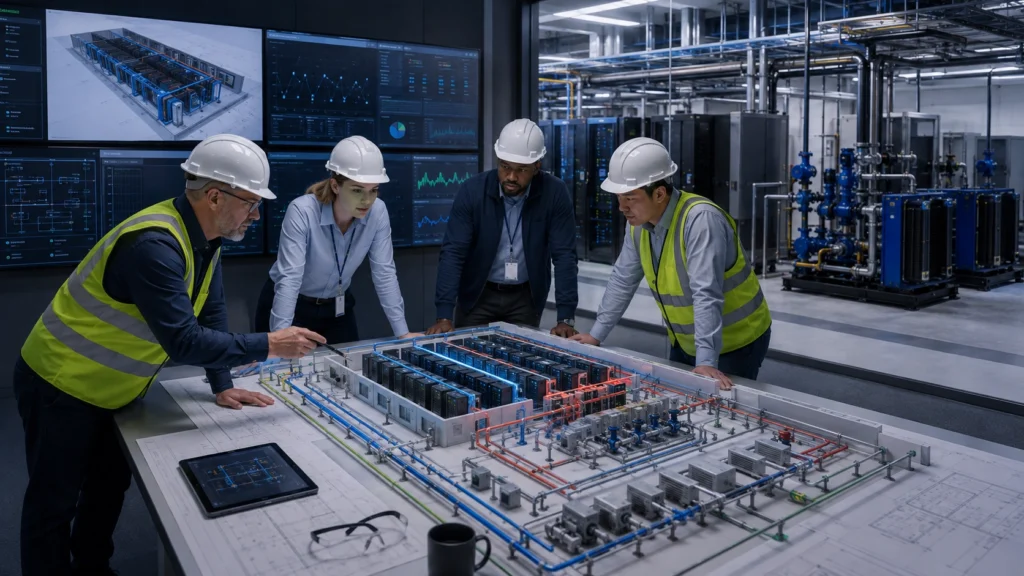
Data center cooling solutions should be integrated with monitoring and maintenance by identifying the conditions that need to be measured, the people permitted to access the systems, the records that should be retained, and the actions required when operating conditions change.
Monitoring may include temperature, humidity, coolant flow, pressure, pump status, valve position, equipment condition, alarms, and leak-detection information where applicable. The appropriate measurements depend on the cooling architecture and equipment specifications. Data should be useful for operational review rather than collected without a defined purpose.
Maintenance planning should identify access routes, isolation procedures, replacement clearances, spare-part requirements, inspection intervals, authorised personnel, and the effect of planned work on the wider infrastructure. Cooling equipment should not be positioned in a way that makes routine inspection unsafe or requires unnecessary disruption to server, power, or network systems.
What Cooling Planning Gaps Can Restrict Cloud Infrastructure?
Common data center cooling solutions planning gaps include relying on average loads, overlooking local heat concentrations, failing to reserve expansion routes, separating mechanical planning from IT planning, and assuming that all future hardware will use the same cooling method.
- Planning from floor area alone: Similar-sized rooms may contain very different rack densities and thermal loads.
- Ignoring partial-load operation: Systems may need to operate across changing deployment and workload conditions.
- Unclear system ownership: Ambiguous boundaries can complicate maintenance, incident response, and colocation responsibilities.
- Insufficient monitoring coverage: Missing or poorly placed sensors may limit visibility into local operating conditions.
- No reserved expansion path: Later cooling additions may conflict with power, network, structural, or access routes.
- Weak documentation: Incomplete operating, maintenance, change, and incident records can reduce audit and operational visibility.
How Do Cooling, Connectivity, Security, and Compliance Interact?
Data center cooling solutions, connectivity, security, and compliance interact because they share physical space, operational procedures, access controls, monitoring systems, and maintenance dependencies. Decisions made for one system may create constraints or risks for another.
Cooling pipework and equipment should not obstruct network routes, electrical access, secure doors, equipment movement, or emergency procedures. Mechanical-system controls should use appropriate access permissions, and changes should be documented consistently with the wider facility-management process.
Cooling equipment does not make a cloud environment compliant by itself. However, controlled access, monitoring records, maintenance documentation, change procedures, and incident evidence may support an organization’s broader compliance-readiness process. Requirements should be assessed against the specific laws, contracts, standards, and internal frameworks applicable to the planned workload.
How Should Cooling Plans Consider Surrounding Communities?
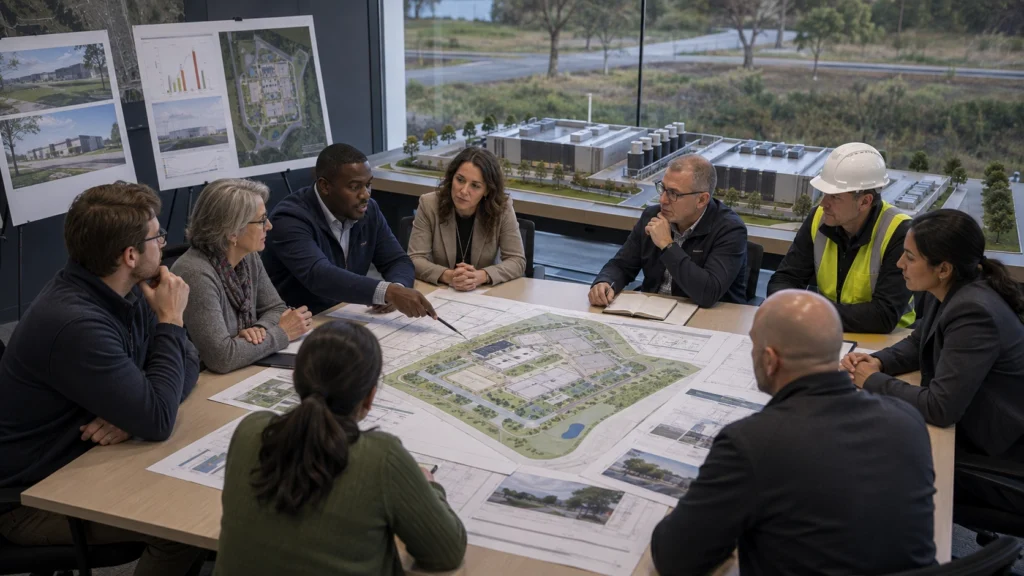
Data center cooling solutions should consider surrounding communities through responsible equipment placement, acoustic review, utility coordination, site design, maintenance planning, and clear communication with nearby residents and organisations. These factors should be addressed before facility layouts and mechanical locations become fixed.
Crystal Peaks Data Centers includes community partnership within its planning approach. Cooling equipment, heat-rejection systems, service routes, screening, setbacks, and operating procedures can all affect how a proposed facility relates to its surroundings. Planning for quiet facility operations requires attention to both normal equipment operation and less frequent activities such as maintenance, testing, deliveries, and construction sequencing.
The company’s infrastructure approach is also planned so that surrounding communities do not experience increased local utility costs. This position should remain connected to careful utility and facility planning and should not be interpreted as a claim about municipal rates, individual electricity bills, subsidies, or broader economic outcomes.
How Is Crystal Peaks Approaching Cooling for Cloud Infrastructure?
Crystal Peaks Data Centers is approaching data center cooling solutions as part of an integrated infrastructure-planning process that also considers power, connectivity, security, compliance readiness, scalability, tenant requirements, and community compatibility. The company plans sites for cloud, enterprise, colocation, and AI-related infrastructure rather than presenting itself as a cloud service provider.
Its planned approach includes self-contained closed loop cooling and long-range evaluation of facility and tenant requirements. The objective is to coordinate thermal design with equipment layouts, monitoring, maintenance access, infrastructure phasing, and responsible site planning.
Organizations assessing future deployments can review Crystal Peaks Data Centers’ information about scalable data center infrastructure planning, enterprise colocation sites, AI data center planning, and data center pre-leasing opportunities. These pages describe planned infrastructure and development approaches and should not be interpreted as confirmation that a particular site, capacity level, or service is currently available.
Frequently Asked Questions
What are data center cooling solutions for cloud infrastructure?
Data center cooling solutions are the mechanical systems, distribution paths, controls, containment methods, monitoring tools, and operating procedures used to manage heat produced by physical cloud infrastructure. The appropriate approach depends on the equipment, density, facility design, operating conditions, and expansion plan.
Why should cooling be planned before cloud infrastructure is deployed?
Early cooling planning helps align rack layouts, thermal capacity, pipework, airflow, monitoring, maintenance access, power systems, and future deployment areas. Delayed planning may introduce physical constraints that are difficult to correct after equipment and infrastructure routes are fixed.
What is self-contained closed loop cooling?
Self-contained closed loop cooling uses a defined loop to circulate coolant through controlled pipework and heat-transfer equipment. Its design should address system boundaries, pumps, heat exchangers, monitoring, leak response, water or coolant quality, maintenance, and the final heat-rejection method.
How can cooling planning support community partnership?
Cooling planning can support community partnership by considering mechanical-equipment placement, acoustic controls, screening, setbacks, maintenance activity, utility coordination, and communication with nearby residents and organisations. Crystal Peaks plans for quiet facility operations and an approach that does not increase local utility costs.
How does Crystal Peaks approach cloud infrastructure cooling?
Crystal Peaks plans cooling alongside power, connectivity, security, compliance readiness, scalability, tenant requirements, and responsible facility development. Its intended approach includes self-contained closed loop cooling, community partnership, quiet facility operations, and planning so surrounding communities do not experience increased local utility costs.
Review Future Data Center Cooling Solutions Requirements
Organizations evaluating data center cooling solutions for future cloud, colocation, enterprise, or AI infrastructure can review the Crystal Peaks Data Centers planning approach and discuss relevant cooling, connectivity, security, capacity, and deployment requirements. Any site status, availability, technical specification, or delivery timeline should be confirmed directly for the proposed project.